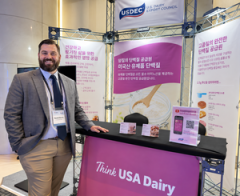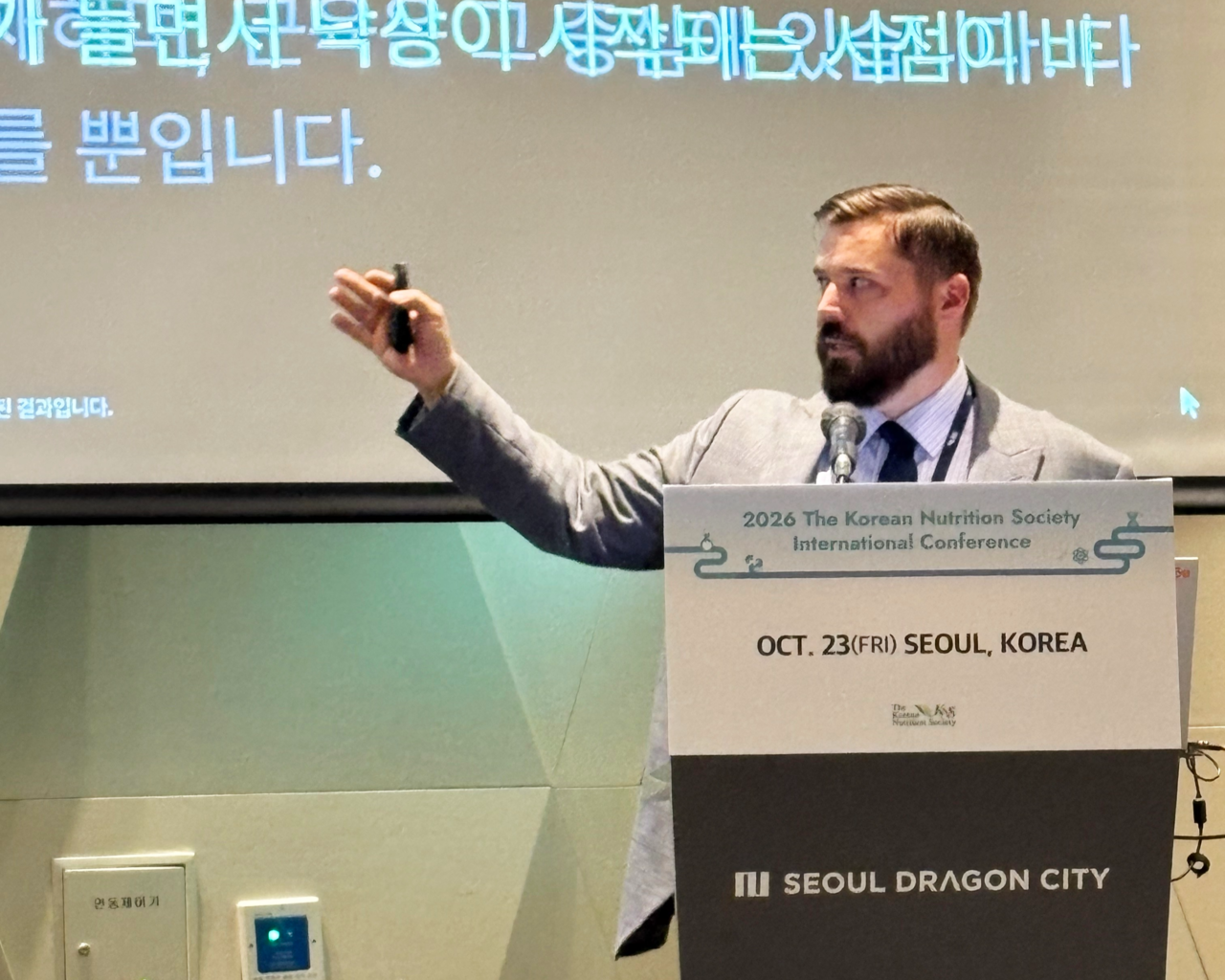
The US Dairy Export Council participated in the 2026 Korean Nutrition Society Fall International Conference on Friday, where it emphasized the importance of protein quality and essential amino acid density under the theme "The Future of Protein Foods: Precision Nutrition in the Age of AI."
Speakers at the conference included David Church, a professor specializing in sarcopenia and protein metabolism, alongside Korean academics. Church, a professor at the University of Arkansas for Medical Sciences, said "food sources rich in essential amino acids are key to muscle health," and introduced strategies particularly beneficial for older adults and GLP-1 drug users, who may experience reduced appetite.
"Rapid weight loss from GLP-1-based obesity treatments can be accompanied by muscle loss — in fact, statistics show that 20 to 40 percent of weight lost by GLP-1 drug users comes from lean mass," he said, and went on to say that consuming enough essential amino acids and high-quality protein becomes even more important during weight loss.
Church said that when evaluating protein quality, the Digestible Indispensable Amino Acid Score, or DIAAS, and essential amino acid content per calorie are important considerations. He explained that foods with high DIAAS scores — such as whey protein and milk protein — provide more essential amino acids per calorie.
"Various dairy products such as milk, whey protein and Greek yogurt are high in protein and also rich in leucine, which promotes muscle protein synthesis," Church said.
He added that older adults need to build more muscle to reduce the risk of sarcopenia. "Structure your diet around foods that are low in calories but highly effective at stimulating protein synthesis, and physical activity must go hand in hand," he advised.
Kim Mo-geon, a professor at Hankuk University of Foreign Studies, presented research on using AI to explore the potential functions of bioactive peptides derived from dairy products, under the theme "AI-Based Discovery of Dairy-Derived Bioactive Peptides: Applying Deep Learning to Compound-Protein Interactions." The research drew attention as an approach to predicting the diverse biological activities of dairy components and expanding the possibilities for functional food development.
Kim Sun-young, a professor at Kyung Hee University, presented on "Changes in Protein Intake Guidelines for Sarcopenia and Frailty: Trends and Future Directions." Kim said it is important for older adults to consume sufficient protein throughout the day, particularly at meals such as breakfast and lunch where intake tends to fall short. She also outlined the scientific background behind the upward revision of protein recommendations for older adults in domestic and international guidelines, and the muscle mass and strength improvements seen when exercise and nutritional management are combined. Drawing on data from the Korea National Health and Nutrition Examination Survey, she presented findings showing that older adults consuming less than 0.8 grams of protein per kilogram of body weight per day were about four times more likely to have lower muscle mass than those consuming 1.2 grams or more. She also addressed the additional benefits of combining leucine-enriched whey protein intake with resistance exercise.
Jung Shin-hyung, vice president of the US Dairy Export Council's Korea office, said "maintaining healthy aging and muscle health is an important challenge facing Korean society," adding that "this session was a meaningful opportunity to present the latest scientific evidence on the role of high-quality protein and to explain why dairy protein consumption is an important nutritional investment in a super-aged society like Korea."
gorgeous@heraldcorp.com