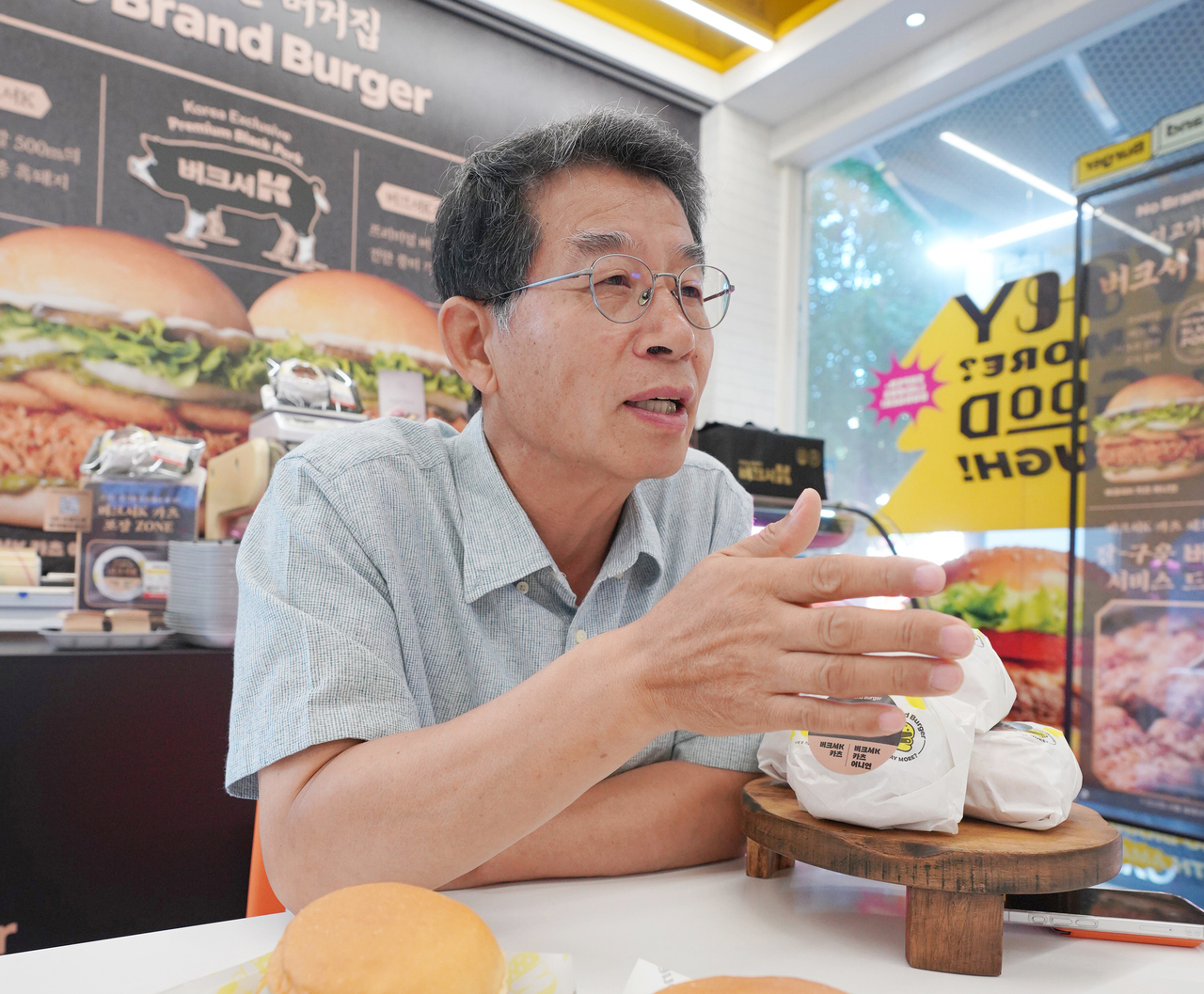
"I believed pork needed to be tender and nutty to leave a lasting impression," said Park Hwa-chun, a livestock breeding expert. "Among the various black pork breeds, I chose Berkshire and adapted it to suit Korean palates — that is how Berkshire K came to be."
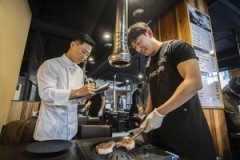
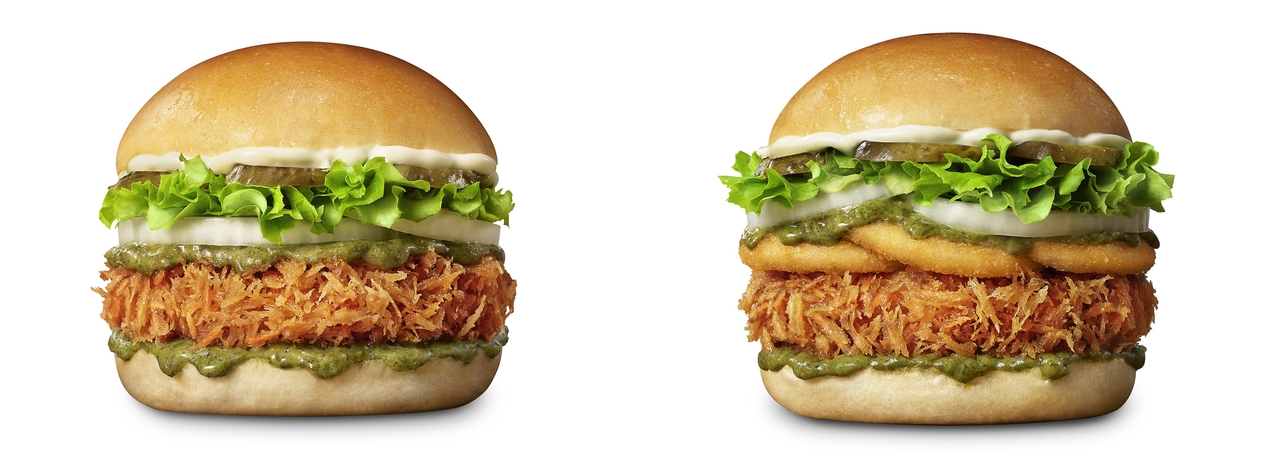
Park introduced Berkshire K, the product of years of research, during a meeting at the No Brand Burger Hongdae branch in Mapo-gu, Seoul. Shinsegae Food recently unveiled the Berkshire K Katsu burger — developed in collaboration with Park — and opened a pop-up store at the location. The store features a butcher-shop-themed Berkshire K display area, and customers who purchase the new menu item receive a samgyeopsal tasting.
Berkshire K is a black pork breed drawing attention in dining scenes both in Korea and abroad. It gained wide recognition through Okdongsik, a hansik restaurant with locations in the United States and France that specializes in pork gomtang — a slow-simmered pork bone soup in which the quality of the meat is paramount. The New York Times named Okdongsik one of its eight best dishes in New York in 2023, cementing its status as a celebrated Korean restaurant in the city. Other establishments using Berkshire K include Tonshou, a Japanese-style tonkatsu restaurant, and Konthai, a Thai restaurant.
"Ordinary native Korean black pigs grow slowly and have low reproductive rates, making them difficult to raise," Park said. "I imported the Berkshire — the leading black pork breed — from the United States and developed it through purebred crossbreeding to suit the Korean environment." The name Berkshire K reflects his goal of creating a distinctly Korean Berkshire.
Park earned his master's and doctoral degrees in animal breeding and genetics, then worked at the Rural Development Administration's National Institute of Animal Science overseeing livestock improvement, and later handled breed improvement at the Korea Federation of Livestock Cooperatives' breeding station. In 2002, he returned to his hometown of Namwon in North Jeolla Province to start farming. His operation, Dasan Yukjong farm, sits at 500 meters above sea level on the slopes of Jirisan. "Pigs run a higher body temperature than humans — between 38.5 and 39 degrees Celsius — so raising them in a cool, elevated environment like the highlands of Jirisan is ideal," he said.

In 2004, Park took up breed development at the suggestion of Namwon city, which proposed a black pork improvement project. He succeeded in developing Berkshire K, a strain with better muscle fiber count, unsaturated fat content and pH levels than ordinary black pigs. pH measures the degree of acidification in meat after slaughter and affects moisture retention, color and flavor.
"A difference in pork's pH level means significant variation across many dimensions — protein, minerals and more," Park said. "The value needs to be sufficiently high for the meat to be moist, tender and nutty." He added that even a 0.1 pH difference is significant, and that Berkshire K registers 0.25 pH higher than ordinary pork. The average pH of standard pork is 5.65; Berkshire K's is 5.9.
Berkshire K now appears across a range of menus. Park's eldest son, Park Ja-yeon, who heads the agricultural corporation Joa, processes Berkshire K into K-charcuterie products — including jamón- and jambon-style cured meats — for export to Hong Kong. Okdongsik uses the front and hind legs to make the broth for its gomtang.
No Brand Burger uses the hind leg. The Berkshire K Katsu patty is a crispy fried cutlet, paired with a perilla pesto that reinterprets the classic Korean combination of pork and perilla leaf wraps. "The hind leg is lean meat with only 5 to 6 percent fat," Park said. "We fry the ground-meat patty to seal in the juices."
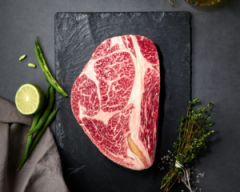
Park also pushed back on the common advice to sear pork over high heat to lock in juices. "Cooking pork over high heat just drives out the flavorful fat quickly," he said. "The juices escape rapidly, leaving the meat dry and reducing its umami." Unlike beef marbling, which distributes fat in thin, dispersed streaks, pork fat is mostly concentrated in clusters. Cooking the meat slowly over low heat allows the fat to melt gradually, he explained, which better seals in the juices.
The quality of the meat can also be gauged on the grill. "If pork has more unsaturated fat than saturated fat, the texture and flavor are better," Park said. "If the fat on the grill does not melt easily and stays white and solid, that means the meat is high in saturated fat, which has a higher melting point."
Park continues to research Korean-style breed development. "In a global era of gastronomy, food identity matters," he said. "We need to build a competitive environment so that future generations can continue to run farms that carry Korean values and identity."
gorgeous@heraldcorp.com