Olive oil leads in omega-9 for cardiovascular health; fish oil beats plant sources for omega-3; Koreans consume too much omega-6 and too little omega-3
A high unsaturated fat content does not automatically make an oil healthy. Unsaturated fats come in several varieties, and the ratio of each differs from oil to oil — so the smarter approach is to identify which fatty acids you are actually lacking.
Unsaturated fats fall into two broad categories: monounsaturated fats (omega-9) and polyunsaturated fatty acids (omega-3 and omega-6).
The key monounsaturated compound is oleic acid, which belongs to the omega-9 family. It has positive effects on blood vessels, metabolism, inflammation and skin. Oleic acid is found in particularly high concentrations in extra virgin olive oil — the top-grade oil cold-pressed on the first extraction — which has earned a global reputation as a health food. A Spanish study published in the New England Journal of Medicine in 2013 found that people following a Mediterranean diet heavy in extra virgin olive oil had a 30 percent lower risk of major cardiovascular events than a control group on a low-fat diet.
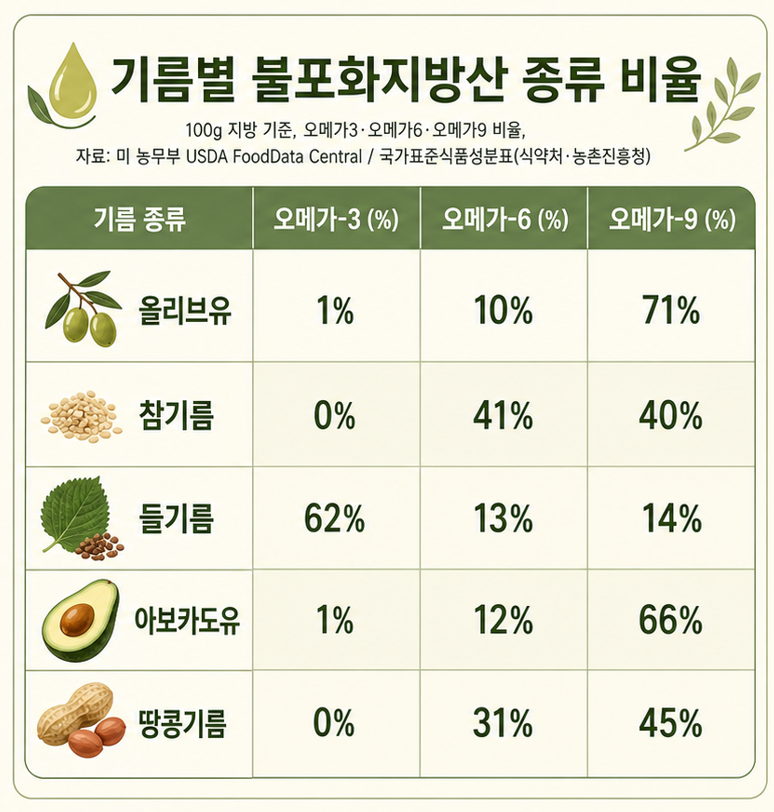
According to USDA data, omega-9 accounts for 71 percent of the total fat in standard extra virgin olive oil, and can reach as high as 83 percent depending on the variety and origin. After olive oil, avocado is the next richest source, at 66 percent.
Some domestically grown peanut oil varieties contain omega-9 levels comparable to olive oil. The "Haeol" cultivar has an oleic acid content of 83 percent — well above the 45 percent found in ordinary peanut oil.
The primary omega-6 compound is linoleic acid. Among cooking oils, grapeseed oil has the highest concentration at 69 percent, followed by sunflower oil (57 percent), corn oil (51 percent) and soybean oil (50 percent). These oils are widely used in processed foods and deep-frying.
Sesame oil contains a balanced mix of omega-6 (40 percent) and omega-9 (40 percent), but has almost no omega-3, at just 0.53 percent. Peanut oil is similarly low, at 0.03 percent.
Omega-3 fatty acids lower blood triglycerides and help prevent blood clot formation, making them a key nutrient for preventing hyperlipidemia. Among plant-based oils, perilla oil has the highest omega-3 content — 62 percent as alpha-linolenic acid — according to the Ministry of Food and Drug Safety. However, the body absorbs plant-based omega-3 far less efficiently than animal-derived omega-3 such as EPA and DHA. For those seeking omega-3 purely to prevent hyperlipidemia, setting aside antioxidants and other nutrients, oily fish such as mackerel, salmon and tuna are more effective than perilla oil.
How do Koreans actually fare on unsaturated fat intake? The picture is unbalanced: too much omega-6, not enough omega-3.
An analysis by nutritionists based on the 2020 Korea National Health and Nutrition Examination Survey found that Koreans consume omega-6 and omega-3 in a ratio of roughly 9.5 to 1 — about 2.5 times higher than the 4-to-1 ratio the WHO recommends. The imbalance is largely driven by heavy consumption of processed foods and fried dishes. The WHO advises cutting back on omega-6 and supplementing with omega-3.
Saturated fat intake is also a concern. According to the KDCA, Koreans' average daily saturated fat consumption rose from 14 grams (29 percent of total fat intake) in 2013 to 17 grams (32 percent) in 2020. Among plant-based oils, coconut oil and palm kernel oil — extracted from the palm fruit kernel and widely used in processed foods — both contain 82 percent saturated fat, while palm oil contains 49 percent.
gorgeous@heraldcorp.com