![Naengmyeon [123RF]](https://wimg.heraldcorp.com/news/cms/2026/08/13/news-p.v1.20260812.3e90432caa484e60876f24c2a260d303_P1.jpg)
"It is better to eat naengmyeon after a hot meal than to eat warm noodles."
That line appears in "Yunssi Eumsikbeop," a late Joseon-era cookbook. Shin Dong-hun, a professor at Dongguk University's Institute of Culture and Scholarship, said Koreans in the Joseon period enjoyed naengmyeon as a finishing course after a meal — much as diners today order it at Korean barbecue restaurants.
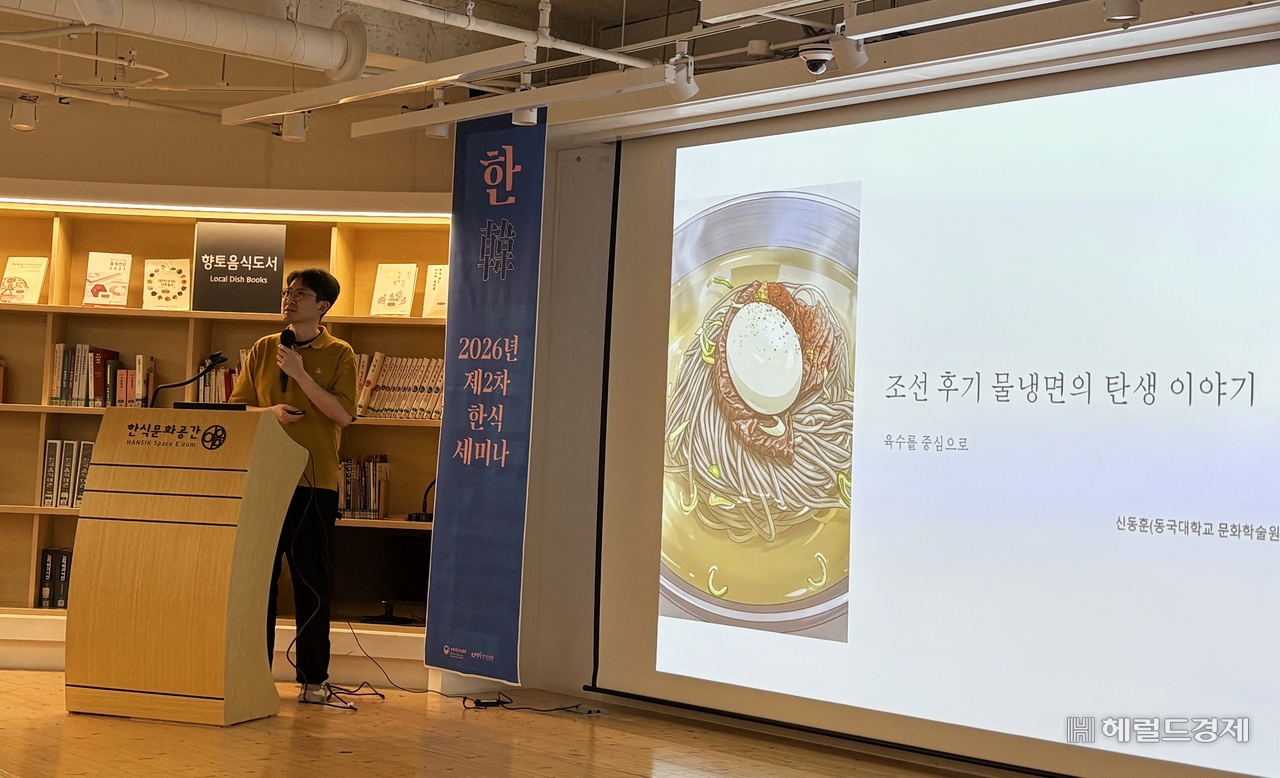
On Wednesday, a hansik seminar titled "Naengmyeon: Past and Future" was held at Eum Hall, a Korean food cultural space in Jongno-gu, Seoul, to explore the dish's historical and cultural dimensions. Shin, who has spent years researching Joseon-era cookbooks and food culture, said cold dishes were common in traditional Korean cuisine because food was often brought straight from earthenware jars kept outside and served at the table. Naengmyeon was one such dish.
The history of naengmyeon stretches back to a cold-noodle tradition spanning the late Goryeo period through the Joseon era. Early forms included "naengdo," a cold wheat noodle dish, and "changmyeon," mung bean starch noodles served in a chilled broth of omija berries and sesame. Later, in the late Joseon period, naengmyeon emerged as buckwheat noodles served in dongchimi — radish water kimchi — broth, topped with radish, yuzu, pear, meat and egg garnish.
Shin said heavy seasoning was avoided in winter vegetable dishes in earlier times because it caused the vegetables to spoil faster and reduced their shelf life. From the 18th century onward, however, the use of spices including chili powder increased, and complex seasoned broths began to develop. The dish gradually evolved from its early dongchimi-based form into something closer to the naengmyeon known today, as meat stock and various seasonings were incorporated.
Naengmyeon's transformation from a winter dish into a year-round staple began during the Japanese colonial period. Park Hyun-su, a professor at Sungkyunkwan University, said naengmyeon chefs from Pyongyang flocked to Gyeongseong — present-day Seoul — during that era, and ice produced by mechanical ice-making machines began moving through retail channels. That combination established naengmyeon as a popular food that could be enjoyed cold even in summer.
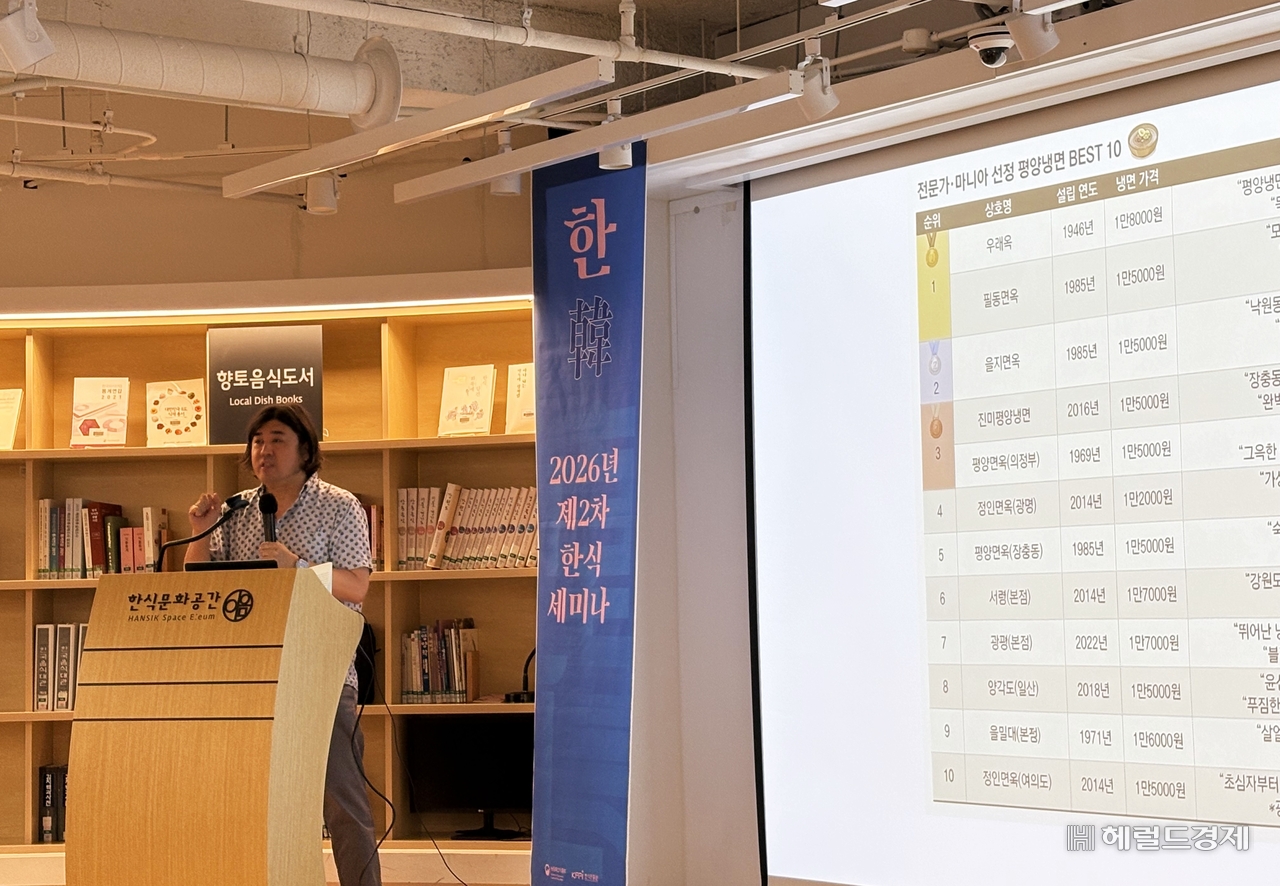
Food critic Lee Yong-jae outlined the direction Pyongyang naengmyeon restaurants should take in the dining market. He began by emphasizing that Pyongyang naengmyeon is a premium dish that commands a high price even though it requires no separate banchan.
Naengmyeon is a rare example of an "ilpum" dish in hansik — a single-bowl preparation combining the main ingredient and accompaniments. Lee said well-known Pyongyang naengmyeon restaurants in Seoul charge 15,000 won ($11) to 18,000 won per bowl, and argued that at fine-dining price levels, even long-established restaurants must deliver service and quality that justify the cost.
He pointed to the stainless steel bowls and chopsticks commonly used at naengmyeon restaurants as an example. While stainless steel vessels helped popularize the dish, Lee said high-priced Pyongyang naengmyeon restaurants could consider switching to brass or ceramic bowls, noting that the feel against the lips when drinking the broth is far more pleasant.
Lee also offered thoughts on the seasoning of Pyongyang naengmyeon's buckwheat noodles. Unlike thin wheat noodles, buckwheat noodles are not salted during kneading — and unlike pasta, which is boiled in salted water, Pyongyang naengmyeon noodles go straight into the broth unseasoned. As a diner eats, osmosis — the movement of water from a less concentrated solution to a more concentrated one — draws salt from the broth into the noodles, leaving the broth tasting flat. Lee suggested that new approaches to seasoning the noodles are worth considering.
He added that while garnishes serve as the banchan of naengmyeon, Pyongyang naengmyeon tends to be light on toppings relative to its price. Garnishes, he said, provide visual satisfaction and can be a point of differentiation for restaurants.
gorgeous@heraldcorp.com